Why Do People With ADHD Change Topics So Quickly?
Why do I change topics so quickly with ADHD? Learn how fast thinking, working memory, and dopamine affect ADHD conversations.
People with ADHD sometimes change topics quickly during conversations.
A discussion may start with one subject, but suddenly shift to something else.
This usually happens because ADHD affects associative thinking, working memory, dopamine, and attention shifting.
To the person with ADHD, the topic change often feels completely logical.
But to others, it can seem sudden or confusing.
Understanding why ADHD conversations jump between ideas can help make these moments easier to understand.
Key Takeaways
• ADHD brains make rapid associations between ideas.
• New thoughts can feel urgent to express.
• Attention shifts easily between topics.
• Topic changes often reflect excitement or engagement.
1. ADHD Brains Make Rapid Associations
ADHD brains are often highly associative.
This means one idea quickly triggers another.
For example:
Someone mentions a restaurant.
An ADHD brain may instantly think about:
• a trip last year
• a funny story
• a different restaurant
• something that happened at dinner
• a related question
Because these ideas feel connected, the conversation may jump to the new thought.
To the person with ADHD, the connection makes sense.
But others may not see the mental steps in between.
Diagram: How ADHD Conversations Jump Between Ideas
ADHD brains often create fast connections between topics.
Interrupting their original stream of thought and changing the topic.
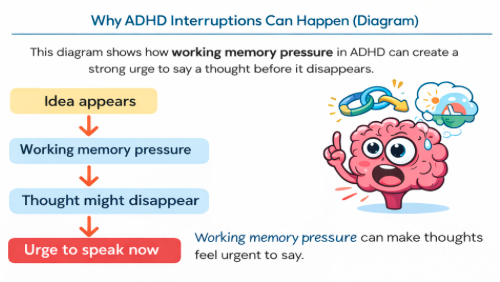
Because ideas connect rapidly, the conversation can shift before the original topic fully finishes.
2. Working Memory Creates Pressure To Speak Quickly
Working memory is the brain system that temporarily holds thoughts.
In ADHD, working memory can be more fragile.
This means a thought might disappear quickly if it is not expressed.
Someone with ADHD may feel a strong urge to say something immediately because they think:
“If I don’t say this now, I’ll forget it.”
That urgency can cause the conversation to shift suddenly.
3. Dopamine Makes Conversations Feel Exciting
Social interaction can be very stimulating for ADHD brains.
When conversations feel interesting or engaging, the brain may release dopamine.
Dopamine increases feelings of:
• excitement
• curiosity
• motivation
This can lead to:
• talking more
• sharing more ideas
• jumping between topics quickly
In many cases, topic shifts happen because the brain is excited about the conversation.
4. Attention Can Shift Easily
ADHD attention systems often respond strongly to new information.
Even small triggers can create new ideas:
• something someone says
• a memory
• a new thought
• something noticed in the room
Each new stimulus can pull attention toward a different topic.
This is why ADHD conversations may sometimes move quickly between subjects.
Why People With ADHD Forget What They Were Saying (Diagram)
People with ADHD often forget what they were saying mid-sentence because the brain struggles to hold and protect thoughts while attention is shifting. This diagram shows how ADHD working memory and attention changes can cause thoughts to disappear quickly.
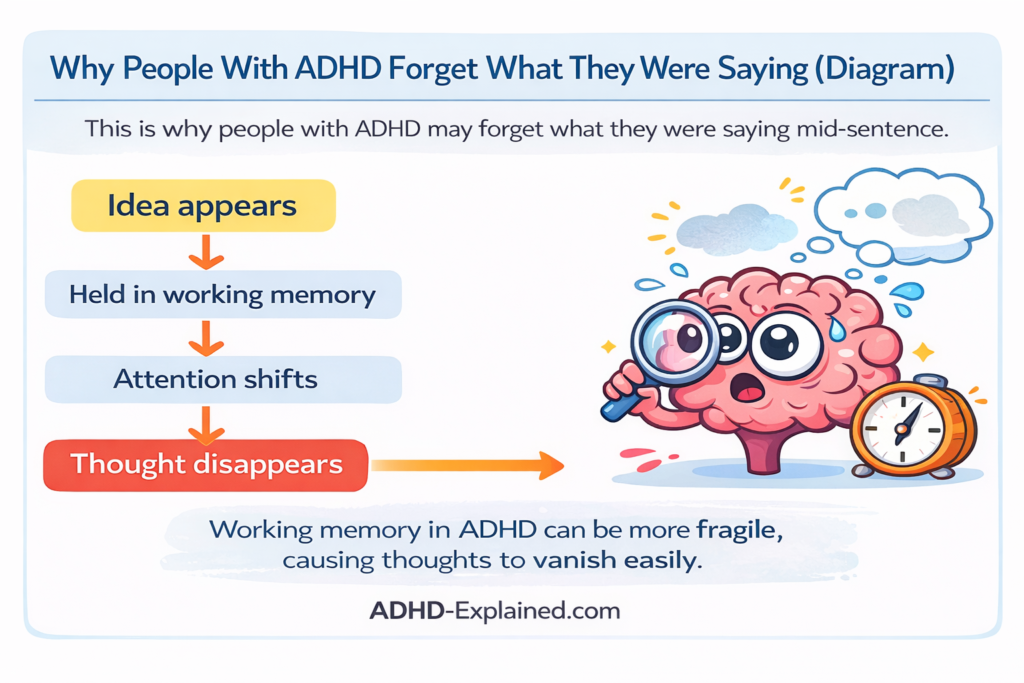
ADHD affects working memory, which is the system that holds thoughts in your mind while you speak. In people with ADHD, working memory can be more fragile, so when attention shifts — even slightly — the original thought can disappear.
This is why many people with ADHD feel like they need to speak quickly before the thought is lost. It’s not impatience — it’s the brain trying to hold onto something that might vanish.
This is a common ADHD experience and is closely linked to symptoms like distractibility, fast thinking, and difficulty maintaining focus in conversations.
5. Topic Changes Often Reflect Engagement
One important thing to understand is that topic shifting is often a sign of interest, not disinterest.
When someone with ADHD is excited about a conversation, their brain may generate many related ideas.
The person may share these ideas as they appear.
This can look like jumping between topics, but it often reflects enthusiasm and engagement.
What Can Help Conversations Feel Smoother
Some people with ADHD find these strategies useful:
Pausing briefly before speaking
Even a short pause can help decide whether to finish the current topic first.
Noticing conversation excitement
If the conversation feels very stimulating, it may help to slow down slightly.
Using small transition phrases…..
Examples:
“Sorry, that reminded me of something.”
“Let me finish this thought first.”
These small adjustments can make conversations easier to follow.
The Important Thing To Remember
If you have ADHD and sometimes change topics quickly, it does not mean you are rude or unfocused.
Often it means your brain is:
• highly associative
• mentally active
• curious
• excited about ideas
Many of the same thinking patterns that cause topic shifts are also the traits that make ADHD conversations creative, engaging, and full of insight.
Understanding how your ADHD brain works can turn confusing moments into self-understanding.
FAQ
Why do people with ADHD change topics quickly?
ADHD brains often make rapid connections between ideas, which can cause conversations to shift between related thoughts.
Is changing topics an ADHD symptom?
Topic shifting is not an official diagnostic symptom, but it often happens because ADHD affects attention, working memory, and idea generation.
Can ADHD topic switching be helpful?
Yes. Rapid connections between ideas can support creativity, problem solving, and engaging conversations.
Remember: having an ADHD brain doesn’t make you less.
You are amazing.
You have endless potential.
Start to understand how your ADHD brain works.
It’s an adventure.