Why do people with ADHD talk so much? Learn how impulse control, working memory, and fast thinking affect conversations — and what can help.
Many people with ADHD find themselves talking more than others in conversations. This can sometimes look like oversharing, interrupting, or blurting things out. But this behaviour isn’t about being rude or self-centered — it’s usually linked to how the ADHD brain processes thoughts, memories, and impulses.
When someone with ADHD hears something in conversation, their brain often rapidly connects ideas, memories, and emotions. Because ADHD also affects impulse control and working memory, there can be a strong urge to say the thought immediately before it disappears.
Understanding this process helps remove shame and replace it with practical strategies that support better communication without suppressing personality or enthusiasm.
Key Takeaways
-ADHD brains make fast associations between ideas and memories.
-Working memory challenges create the feeling of “say it now or forget it.”
-Impulse control differences can make it harder to pause before speaking.
-Talking a lot is often a sign of enthusiasm, connection, and engagement, not rudeness.
-With awareness and a few tools, ADHD communication can become more balanced and effective.
The Important Thing to Know
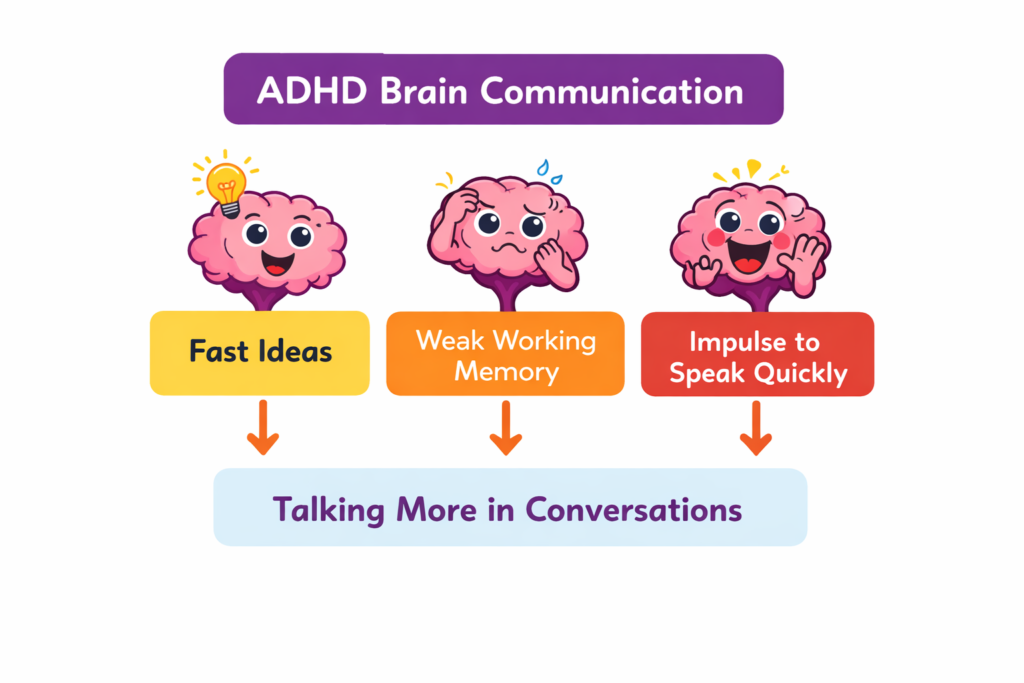
Talking a lot with ADHD is usually driven by three brain processes working together.
1. Rapid Idea Generation
The ADHD brain is excellent at pattern recognition and connections. When someone says something in conversation, your brain may instantly connect it to multiple related ideas or memories.
This creates a sudden “idea pop-up” moment.
2. Working Memory Pressure
ADHD often affects working memory — the system that holds thoughts briefly in your mind.
When a thought appears, the brain often sends a message:
“Say it now or it’s gone.”
That urgency can make waiting feel uncomfortable.
3. Impulse Control Differences
ADHD also affects the brain’s pause system (executive function). That means the gap between having a thought and saying it can be much smaller.
So the process often looks like:
Conversation → Idea appears → Urge to share → Blurt.
What Can Help
The goal isn’t to talk less — it’s to create a small pause between thought and speech.
A few strategies can help:
1. Use the “mental parking lot”
If a thought pops up, mentally tell yourself:
“Hold that thought.”
Even a 2-second pause can allow someone else to finish speaking.
2. Write or note ideas
If you’re in longer conversations or meetings, jot down thoughts quickly. This removes the pressure of losing the idea.
3. Use curiosity cues
Try asking a question before sharing your idea.
Example:
Instead of jumping in with a story, try:
“Has anyone else experienced that?”
This keeps the conversation balanced.
4. Practice the “three sentence rule”
When sharing a story, try to keep the first version to three sentences, then pause.
You can always add more if people ask.
One More Important Point
Talking a lot with ADHD often comes from enthusiasm and emotional engagement.
People with ADHD frequently:
– Tell stories vividly
– Share personal experiences
– Show excitement in conversations
– Connect deeply with others
– These are social strengths, not flaws.
– The goal is simply to channel them in a way that works in group conversations.
– When people understand how their brain works, communication becomes more intentional rather than impulsive.
FAQs
Is talking a lot a symptom of ADHD?
It can be. ADHD often affects impulse control and working memory, which can lead to blurting thoughts or speaking more in conversations.
Why do people with ADHD interrupt others?
Interrupting usually happens because a thought feels urgent to say before it disappears from working memory.
Do people with ADHD overshare?
Sometimes. Rapid connections between ideas and emotions can lead to sharing stories quickly without filtering first.
Is talking a lot a bad thing?
Not necessarily. Many people with ADHD are engaging storytellers and enthusiastic communicators. The key is learning when to pause and when to share.
Can ADHD communication improve?
Yes. With awareness and simple strategies, many people with ADHD learn to balance listening and sharing more comfortably.